
The Talent Filter: Why AI-Proctored Skills Testing is the Only Way to Vet Offshore Accountants
- Sarbeswar Sinha

- Apr 2
- 3 min read

Traditional resumes are statistically useless for vetting offshore accounting talent. To prevent compliance breaches and ensure US GAAP proficiency, modern CPA firms must implement multi-measure, AI-proctored skills testing (evaluating error detection, bank reconciliations, and complex revenue recognition) before an interview is even scheduled. A master's degree on a PDF means nothing if the candidate cannot practically apply GAAP principles in a remote environment. You must filter for applied competence, not just credentials.
The most dangerous lie in global scaling is the "perfect resume."
When a US CPA firm decides to hire offshore, they are typically flooded with hundreds of applications. The resumes look incredible—boasting MBAs, US GAAP certifications, and years of experience. But when that $8/hour "Senior Accountant" actually logs into QuickBooks Online, they don't know how to book a complex journal entry or spot a glaring liability discrepancy.
In a remote, borderless office, traditional interviewing is a failing metric. You cannot assess practical accounting nuances through a 30-minute Zoom call. If you rely on resumes and casual interviews, you are gambling your firm's compliance on a piece of paper.
To build a truly elite global operation, strategic firms have entirely abandoned the resume-first model.
The 3-Step GAAP Stress Test for Vetting Offshore Accountants
We have already established the [true cost of an offshore bookkeeper]. The only way to capture that 60% labor arbitrage without paying the "rework penalty" is to aggressively filter out imposters at the top of the funnel.
At BookHeaven, our vetting process assumes the resume is fabricated until proven otherwise. Essential domain competencies must be tested rigorously through practical, timed simulations.
Before a candidate ever speaks to a human manager, they must pass a tri-level stress test:
Testing Vector | What We Evaluate | Why It Matters to US Firms |
1. Foundational GAAP | Accrual accounting, consistency principles, and matching principles. | Ensures the bookkeeper isn't just treating everything as cash-basis data entry. |
2. The "Messy Ledger" Test | Candidates are given a broken bank reconciliation with intentional errors to find and fix. | Tests diagnostic ability. A good bookkeeper enters data; a great one finds the missing $4,000. |
3. Complex Recognition | Interest expense accrual, deferred revenue, and liability identification. | Critical for CPA firms that offer high-level advisory and fractional CFO services. |
During my time managing the very workflows that powered QuickBooks—first at IBM and later through the transition to Concentrix—I saw this exact resume illusion play out firsthand. We would receive applications from highly credentialed "Senior Accountants" who looked flawless on paper. Yet, when we placed them into a simulated "Messy Ledger" environment, they would completely freeze. I watched candidates with master's degrees fail to properly grasp accrual versus cash basis or execute a basic interest expense accrual. A credential means absolutely nothing when faced with a live, corrupted ledger.
The Necessity of AI Proctoring
A skills test is only as valid as the environment it is taken in. In a globalized remote workforce, the risk of a candidate using ChatGPT, phoning a friend, or having someone else take the test entirely is a massive operational vulnerability.
To protect the integrity of these assessments, enterprise-grade offshore partners utilize platforms equipped with AI-driven proctoring (such as WeCP’s Sherlock AI).
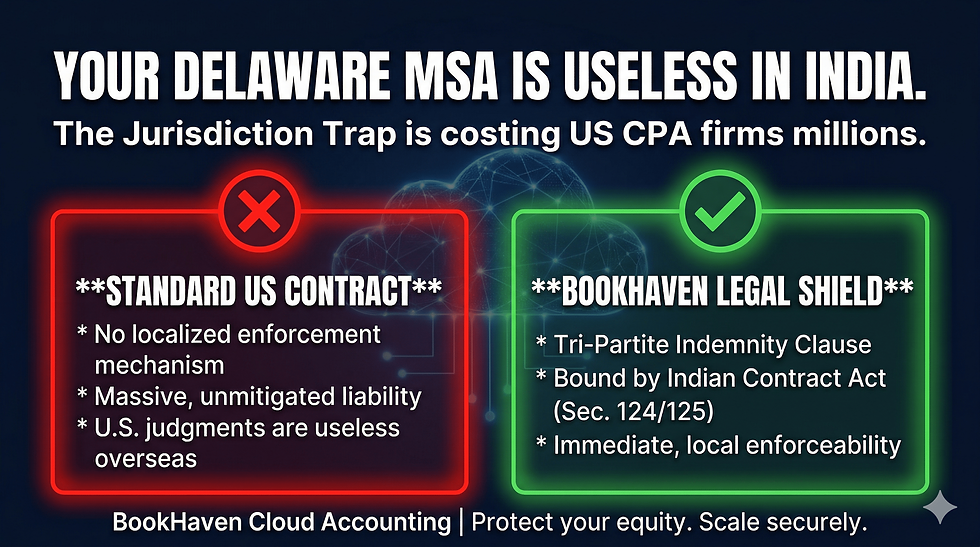
I learned the absolute necessity of airtight identity and security protocols directly from Intuit. When Intuit outsourced to IBM India, the legal architecture was staggering—we operated under strict Master Services Agreements (MSAs) that explicitly defined risk, indemnity, and subcontractor rules. To protect unreleased software and sensitive financial data, they enforced comprehensive Non-Disclosure Agreements (NDAs) down to the individual employee level, tracking exactly which call center agent had access to the data. We apply that exact same enterprise-grade rigor at BookHeaven. We don't just proctor the exam; our AI verification locks the candidate's identity to their workstation, ensuring the person who passes the rigorous GAAP test is the exact same verified individual touching your clients' financials on day one.
These systems utilize webcam monitoring, screen-lock technology, and keystroke analysis to detect impersonation or hidden assistance with over 92% accuracy. If an offshore provider cannot prove how they proctor their GAAP exams, their test results are meaningless.
Stop Buying Resumes; Start Buying Verified Capacity
A rigorous vetting protocol is the operational twin to an [Ironclad Offshore MSA]. The contract protects you legally, but the skills test protects you practically.
The 2026 workforce mandate requires moving from "trust" to "verification." When you partner with a dedicated offshore ecosystem, you bypass the resume lottery entirely. You step into a pipeline of pre-vetted, GAAP-verified professionals who have already survived a gauntlet designed to break underqualified candidates.
If you are currently staring at a stack of 100 offshore resumes on your desk, throw them away. Stop trying to find a needle in a haystack of PDFs and start demanding verified, practically tested competence that protects your firm's compliance from the moment they log in.

Comments